
Buying Guide
The Australian Guide to Buying Probiotics, Prebiotics & Seed Supplements
By the Probiotic Science Team · 10 min read
The gut health supplement market in Australia has exploded over the past five years. Walk into any pharmacy or health food store and you'll be confronted with a wall of products — capsule probiotics, powdered prebiotics, seed blends, fibre supplements, and everything in between. The marketing language is persuasive, the packaging is beautiful, and the price tags are significant. So how do you know what's actually worth buying?
This guide cuts through the noise. We'll explain the difference between probiotics, prebiotics, and seed supplements, walk you through what to look for on a label, and explain why pairing a high-quality supplement with a science-backed probiotic app is the most effective approach to gut health available to Australians today.
Understanding the Basics: Probiotics, Prebiotics, and Why Both Matter
Before you spend a dollar, it helps to understand what you're actually buying — and why the distinction between probiotics and prebiotics matters enormously.
Probiotics are live microorganisms. When consumed in adequate amounts, they confer a health benefit by colonising the gut with beneficial bacteria. The most studied strains belong to the Lactobacillus and Bifidobacterium families, though thousands of strains exist. Probiotics are found naturally in fermented foods like yoghurt, kefir, kimchi, sauerkraut, and miso. They are also sold as concentrated capsule, powder, or liquid supplements.
Prebiotics, on the other hand, are not living organisms at all. They are specific types of fibre and plant compounds that selectively feed the beneficial bacteria already living in your gut. Without an adequate supply of prebiotics, even the highest-quality probiotic supplement will struggle to establish itself in your microbiome. Think of it this way: probiotics are the seeds, and prebiotics are the soil and fertiliser that determine whether those seeds can take root and flourish.
The most powerful gut health outcomes come from using both together — a strategy scientists call a synbiotic approach. This is the foundation of the Probiotic programme: the Daily30+ seed supplement delivers a broad spectrum of prebiotic plant fibres, while the Probiotic App guides your diet toward foods that further support your unique microbiome, as revealed by your personal gut health test.
What to Look for When Buying a Probiotic Supplement
Not all probiotics are created equal. Here are the key factors to evaluate before purchasing any probiotic product in Australia.
Strain specificity. Generic probiotic capsules that list only "Lactobacillus acidophilus" without specifying the strain are difficult to evaluate. Scientific research is conducted on specific strains, not genera. Look for products that name both the species and the strain code (e.g., Lactobacillus rhamnosus GG). If a product can't tell you which strain is inside, that's a red flag.
Colony-forming units (CFUs) and viability. CFU count tells you how many live bacteria are present at the time of manufacture — but what matters is how many survive to reach your gut. Temperature, moisture, and stomach acid all kill bacteria during transit. Look for products that guarantee CFU counts at the time of expiry, not manufacture, and that have enteric coating or other delivery technology to protect bacteria from stomach acid.
Storage requirements. Many high-quality probiotic capsules require refrigeration to maintain viability. If a product claims to be shelf-stable despite containing live bacteria, check the science behind that claim carefully. Some newer strains and encapsulation technologies genuinely support ambient storage, but this should be independently verified.
Third-party testing. Australia's Therapeutic Goods Administration (TGA) regulates probiotic supplements, but the level of scrutiny varies. Look for products that have been independently third-party tested for potency, purity, and label accuracy. Reputable brands will make these results available on request.
Personalisation. Here is the most important insight modern gut health science has produced: the same probiotic food or supplement can have completely different effects in different people. A food that scores excellently for one person's microbiome may barely register for another's. This is why taking a one-size-fits-all capsule probiotic without knowing your gut composition is essentially guesswork. The Probiotic Gut Health Test removes that guesswork entirely, giving you the data to make genuinely personalised decisions.
The Rise of Seed Probiotics: Why Seeds Are the Future of Gut Supplements
One of the most significant developments in gut health nutrition over the past decade has been the growing understanding of seed probiotics — that is, the profound role that seed-based foods play in nourishing the gut microbiome.
Seeds are among the most nutrient-dense foods on the planet. They contain concentrated amounts of prebiotic fibres, omega-3 fatty acids, plant proteins, polyphenols, and micronutrients — all within a small, practical package. Different seeds feed different bacterial populations in the gut, which is why consuming a variety of seeds is far more valuable than consuming large amounts of any single variety.
Flaxseeds, for example, contain lignans — plant compounds that gut bacteria convert into compounds with anti-inflammatory properties. They also provide mucilaginous fibres that create a soothing gel in the intestine, slowing digestion and providing a sustained fuel source for beneficial bacteria. Chia seeds offer a different fibre profile, along with exceptional omega-3 content. Hemp seeds contribute plant protein and gamma-linolenic acid. Pumpkin seeds add zinc and a distinct prebiotic fibre type. Sunflower seeds bring vitamin E and selenium.
The key principle is this: diversity drives diversity. The more different types of plants — and seeds in particular — you consume, the more diverse your gut microbiome becomes. And a diverse microbiome is one of the strongest predictors of overall gut health, immune function, metabolic health, and even mental wellbeing through the gut-brain axis.
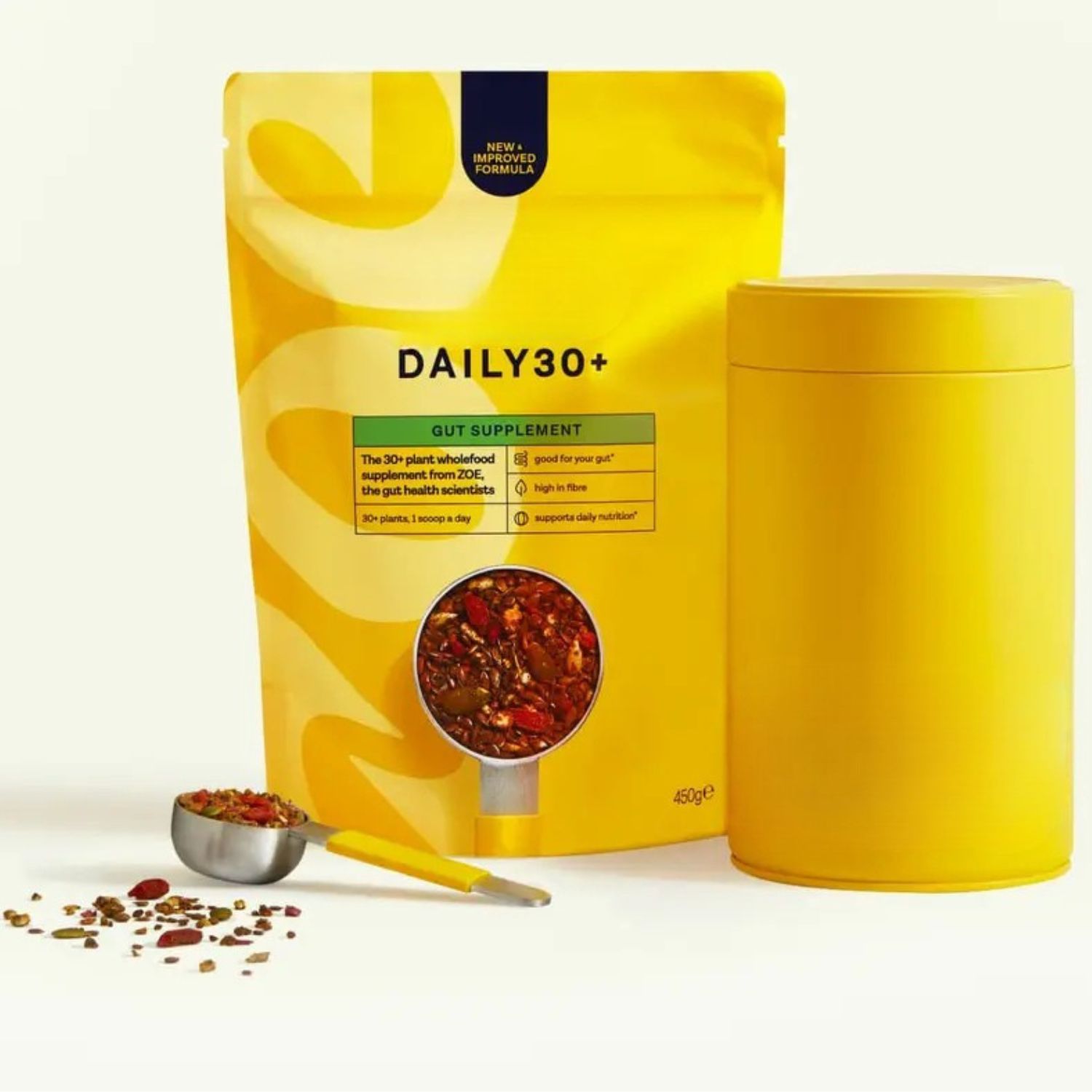
This is the scientific rationale behind the Daily30+ Probiotic Gut Supplement. Rather than delivering one or two seed ingredients in high quantities, Daily30+ combines 30+ different whole plant ingredients — including multiple seed varieties — in proportions designed to maximise microbiome diversity. One scoop per day provides a matrix of prebiotic fibres, polyphenols, omega-3s, and micronutrients that would be impractical to obtain from whole foods alone without enormous dietary effort.
Seed Supplements vs. Traditional Probiotic Capsules: Which Should You Choose?
This is one of the most common questions we receive, and the honest answer is: it depends on your goal — and ideally, you'd consider using both in a complementary way.
Traditional probiotic capsules are well-suited for specific, targeted applications: recovering gut flora after a course of antibiotics, managing specific digestive conditions under medical supervision, or introducing particular bacterial strains that your gut test has revealed to be deficient. For these targeted purposes, a high-quality, strain-specific capsule probiotic can be genuinely valuable.
Seed-based prebiotic supplements like Daily30+ are better suited for long-term, sustainable microbiome support. They work by continuously nourishing the bacteria already resident in your gut, encouraging diversity and resilience over time. This approach is more aligned with how human gut health evolved — through regular consumption of a wide variety of plant foods — and is increasingly supported by large-scale nutritional research as the most effective long-term strategy.
For most healthy Australian adults looking to improve their gut health, energy, digestion, and overall wellbeing, a seed-based prebiotic supplement combined with a probiotic nutrition app is the highest-value investment they can make. The supplement provides the nutritional foundation; the app ensures your entire diet is working in harmony with your unique microbiome.
Why a Probiotic App is Now Essential — Not Optional
Ten years ago, gut health advice was simple: eat more fibre, take a probiotic capsule, and avoid processed food. That advice was not wrong, exactly, but it was incomplete — and in some cases, it was actively misleading. We now know that what is healthy for one person's gut may be neutral or even counterproductive for another's.
This is where a probiotic app changes everything. The Probiotic App is not a generic calorie counter or food diary. It is a personalised nutrition platform that uses your gut health test results to assign individualised food scores to everything you eat. A bowl of oats might score 85 for you and 40 for your partner. A glass of kefir might be transformative for one microbiome and irrelevant for another. Without knowing your gut composition, you cannot know which foods are truly working for you.
The Probiotic App makes this personalisation accessible and practical. You log meals by snapping a photo or scanning a barcode — the app does the analysis. Your daily diet quality score reflects how well your food choices are nourishing your specific microbiome. Over time, you build an increasingly accurate picture of the foods that consistently score well for your gut, making better decisions automatic rather than effortful.
The app also includes expert-led learning modules — covering topics like fermented foods, plant diversity, seed probiotics, fibre types, and the gut-brain axis — written and reviewed by gut health scientists. These modules don't just tell you what to eat; they explain the science behind each recommendation, so you understand why a food scores the way it does for your microbiome.
How to Get Started: A Practical Buying Guide for Australians
If you're ready to invest in your gut health seriously, here is the most effective sequence we recommend for Australian consumers.
Step 1: Take the Probiotic Gut Health Test. This is the non-negotiable foundation. Without knowing your gut microbiome composition, every supplement and dietary decision is generic rather than personalised. The at-home test kit is straightforward to use and takes only a few minutes. Your results — typically available within a few weeks — are the data that powers everything else in the Probiotic programme.
Step 2: Download the Probiotic App. Once your gut test results are uploaded, the app becomes your personalised gut health navigator. Start logging meals immediately — even before your results arrive — to build the habit and establish a baseline diet quality score. The app is available for both iOS and Android and is designed to be genuinely simple to use daily.
Step 3: Start Daily30+. Begin with a half-scoop of the Daily30+ Probiotic Gut Supplement for the first week to allow your gut to adjust to the increased plant diversity. Move to a full scoop from week two. Mix it into yoghurt, a morning smoothie, porridge, or simply stir it into water. Log it in the app each day as part of your diet quality tracking.
Step 4: Follow the six-week programme. Our gut health programme is structured around a six-week transformation. Use the app's expert modules, respond to your personalised food scores, and pay attention to how you feel week by week. Most members report noticeable improvements in digestion and energy within the first three to four weeks, with more significant changes to their diet quality score and overall wellbeing by week six.
Step 5: Reassess and adapt. Gut health is not a destination — it is an ongoing practice. After six weeks, consider retesting your gut microbiome to measure change, continue using the app to maintain your personalised food scores, and maintain your Daily30+ intake as part of your long-term routine. The science is clear: consistent, diverse plant intake and ongoing microbiome monitoring are the highest-value long-term investments in your health.
The Bottom Line
The Australian supplement market is crowded with products making bold claims backed by thin evidence. The Probiotic approach is different: it is built on the largest human nutrition research programme in the world, validated by a gold-standard Randomised Controlled Trial, and delivered through a platform that personalises every recommendation to your unique gut microbiome.
Whether you are new to probiotics, already familiar with prebiotics, or specifically interested in the emerging science around seed probiotics, the principle is the same: generic advice produces generic results. Personalised, science-backed nutrition — guided by your gut health data and supported by a daily seed supplement — produces real, measurable, lasting change.
Your gut is unique. Your nutrition should be too.